
 |
| New East Manchester. |
Industrialisation
In the 18th and 19th century the UK experienced an unprecedented growth in agricultural production, fuelled by mechanised farming techniques, freeing up significant proportions of the population from agrarian practices. This burgeoning work force were drawn to the cities in search of better economic opportunities and found it in the workshops of an expanding industrial economy. For the first time in history the majority of the population was now divorced from the land that had traditionally sustained them.
As the cities choked and strained under the pressure of “deleterious physical spaces increasingly devoid of any natural elements” (Latham et al. 2009: 56) many people, justifiably, didn’t like what they saw. Lord Rosebery, speaking as Chairman of the London County Council where rural flight had swelled the capital’s population to 6.5 million, compared it to a “tumour, an elephantiasis sucking into its gorged system half the life and the blood and bone of the rural districts” (Howard 1902/2010: ii). Reacting to these conditions an appetite for socialist reform emerged, self-charged with tackling both the physical and moral degradation afflicting the masses. This manifested itself through “early pieces of social legislation, designed to prevent political unrest and disease” (Canniffe 2006: 45) and new utopian visions that attempted to heal the division between town and country, proposing radical changes to the embryonic industrial society.
A romantic yearning for man to return to nature can hardly be claimed to be the sole property of this era. The Arts and Craft movement, instigated by William Morris and inspired by John Ruskin, would seek to align nature with the realms of architecture and urban design. Ruskin, an “early advocate of town planning” (Glaeser 2011: 202) and critic of industrialisation, urged that “from any part of the city perfectly fresh air and grass and the sight of far horizon might be reachable in a few minutes walk” (Howard 1902: 1). This desire for closeness to nature was reinforced by poor sanitation and miasma theory so that the virtues of this relationship were, at the time, intellectually informed. Furthermore, “historically, the wealthy managed to combine the city and country by having two homes” (Glaeser 2011: 203) and as global income levels rose more people wanted to share in the town and country experience.
One solution was the development of municipal parks, such as Phillips Park in Manchester (1846) or, on a larger scale, the Frederick Law Olmstead designed Central Park in New York (1857). Simultaneously providing recreational spaces and ‘clean lungs’ for the city, these new facilities failed to tackle other issues and as such other strategies were put forward that didn’t require interventions into the existing urban fabric but instead focused on entirely new developments. These included Ruskin’s proposal for a “compact, walled town, girded by a ‘belt of beautiful garden and orchard round the walls’” (Glaeser 2001: 202) and projects instigated by a “series of benign industrialists” (Canniffe 2006: 45) who created model villages at Saltaire (1853), Bourneville (1879) and Port Sunlight (1888). Operating between these, Ebenezer Howard would propose his own variant in the shape of the Garden City, a planned municipal welfare town, with a mixed economy, surrounded by a greenbelt. Howard outlined this vision in his 1898 book To-morrow: A Peaceful Path to Real Reform and would go on to champion the Garden City movement that would result in the garden cities of Letchworth (1903) and Welwyn (1919).
The Birth of Modern Town Planning
Ebenezer Howard “has the strongest claim to be the founder of modern town planning” (Schoon 2001: 33), despite his position as an amateur not professionally associated with either architecture or urbanism, because of the wider reaching influence of his short book. Howard was able to synthesise an eclectic range of previously published sources into a coherent diagram that was a solution for reintegrating man with nature. Despite some critics dismissing the text as yet another piece of utopian literature interest in it gained momentum, and the Garden City Association forming in 1899 (predating the Town Planning Institute by 15 years) followed by a second edition in 1902 (revised, with the new title Garden Cities of To-morrow) that was translated into numerous languages for a global audience.
The book is a “third way between socialism and individualism” (Schoon 2001: 33) that reflects Howard’s political philosophy and which he hoped would provide a platform for social reform. Although he did not belong to the socialist mainstream his political ideologies were closely aligned to those of the Co-operative movement. The word ‘co-operation’ appears in one of the book’s diagrams, ‘The Three Magnets’, highlighting the importance “of groups of individuals coming together freely to create socialism by practical actions” (Ward 2002: 22). However, the socialist reformist message was lost and instead the key principles behind the urban planning strategy were divorced from the economic and social argument. It is from the selective application of these physical strategies, including, closeness to the countryside, high density, walkability, and a protective green built, that modern town planning has emerged.
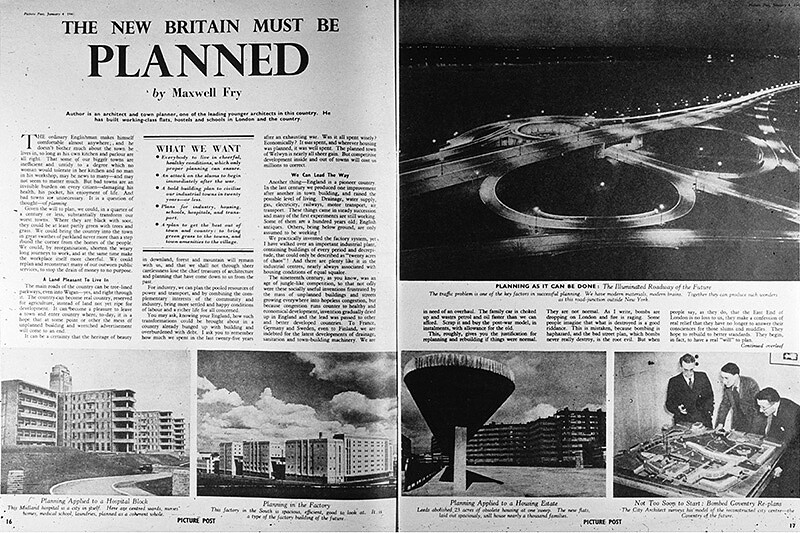 |
| 'The New Britain Must Bet Planned', 1941 Article (Image Copyright: MMU Visual Resources) |
An integral part of the “new discourse” on town planning (2002: 32), was the Garden City Association (renamed the Town and Country Planning Association in 1941), initially chaired by Howard. Furthermore, the construction of Letchworth and Welwyn would act as catalysts for change that culminated in, but was not limited to, the 1946 New Towns Act. However, “when people talk about New Towns they don’t mean the garden cities” but places that “were intended to be self-sufficient but became just another part of the commuter belt” – such as Crawley or Stevenage (Hatherley 2010: 50). Planners also made use of greenbelts as weapons to counteract sprawl. Whilst appearing to have been successful, “widen your view and you find that development has merely leapfrogged beyond the Green Belt” (Schoon 2001: 56). Howard’s failure to originally take account of the car meant that life in the “bounded city” was not intensified but inadvertently led to “loose indefinite sprawl” (Fishman 2002: 64).
 |
| Exploring the relationship between Greenbelts and Sprawl |
Towards A Functional Garden City
Twenty-four years after the publication of Howard’s book a young Architect, Le Corbusier, exhibited the ‘Ville Contemporaine’ (Contemporary City), at the Salon d’Automne, a proposal for twenty-four, sixty-story towers surrounded by parkland (Contandriopulos & Franics 2008: 193). The Ville Contemporaine, partly published in L’Esprit Nouveau, would provide the foundation for his first book on urban theory, Urbanisme (1925). As Le Corbusier developed his designs away from a radial, hierarchic model towards a classless and theoretically limitless, linear, model the Ville Radieuse (Radiant City, 1935) emerged and “took the open-city concept of the Ville Contemporaine to its logical conclusion” (Frampton 1980/2007: 180). Ville Radieuse, together with studies undertaken by the Congrès International d'Architecture Moderne (CIAM), during the cruise to Athens in 1933, formed the 95 propositions for a functional city in Le Corbusier’s The Athens Charter (1943). Observations in it echo those of Howard and his contemporaries, including the inadequate access to “verdant areas” in cities. By outlining his own proposals for social reform (informed by Syndicalism, rule by industrial elites) Le Corbusier would set out a “vision of a modern city that would not fundamentally change over the next forty years” (Contandriopulos & Franics 2008: 193).
The Ville Radieuse has been described as “the garden city on stilts and steroids, pumped up into the sky” (Schoon 2001: 218). Inspection of both the Ville Contemporaine and Ville Radieuse reveal a number of comparisons with the Garden City, principally the relationship between housing, parkland and greenbelt. In the pre-war years Corbusier had been influenced by the ideas of Camillo Sitte but would later abandon ‘the pack-donkeys way’ (Le Corbusier 1929: 5-12) towards the straight line, particularly after viewing Tony Garnier’s own vision of modernity, Uné Cite Industrielle in 1917 (Contandriopulos & Franics 2008: 193).
Tony Garnier, a French Architect, began working on the Cite Industrielle (Industrial City) whilst he was a student in Rome in 1899. Garnier himself was influenced by the “utopian and positivist traditions of Charles Fourier and Saint-Simon, as well as the more recently published urban ideas of Frederic Le Play and Ebenezer Howard” (2008: 123). The Cite had a limited impact on modern urban planning when compared with Howard, “despite the obvious impact on the urbanistic thought of Le Corbusier” (Frampton 1980/2007: 103). Whereas Howard was able to realize two model towns Garnier’s work was restricted to isolated projects, although the extent to which the model Garden Cities are representative of Howard’s utopian vision is in itself questionable.
All three proposals rely on zoning to separate the different functions of a city, with residential, industrial and commercial areas defined in plan. However, differences appear in the aesthetic treatment associated with the separate zones and their respective functions. Being “intimately linked to the development of the Arts and Craft movement” (Frampton 1980/2007: 103) the civic, residential and industrial buildings of a Garden City would be clearly delineated in architectural form. Garnier reinforces the distinctions between industrial, residential and civic buildings “to aid inhabitants in the reading of their urban environment” but that this “evaporates in the proposals of those that follow him” (Canniffe 2006: 50-51). This process of ‘evaporation’ is borne out in the Ville Radieuse where buildings are reduced to a series of slabs and towers. Le Corbusier takes Howard’s Grand Avenue (Howard 1902: 4-5) to its logical conclusion, freeing up the ground plain into continuous parkland by elevating both buildings, on pilotis, and highways.
As visually dissimilar as the two visions of Ebenezer Howard and Le Corbusier are they are each borne of a concern for their, chronologically respective, urban environments. Both attempt to engineer new urban spaces to provide new possibilities for integrating the natural (country) and artificial (town).
Enter “Mother” Jacobs
The Death and Life of Great American Cities (1961) marks a change in direction for future visions of the city. Its author, Jane Jacobs, in the tradition of Howard as an amateur, offered up her own observations on what she saw was going right and wrong in cities, focusing on her own neighbourhood of Greenwich Village, New York. Described 40 years later as “among the most important and hopeful books ever written about cities” (Schoon 2001: 219) and praised for knowing that “you need to walk a city’s streets to see its soul” (Glaeser 2011: 11), Jacobs urged change but on a more modest scale than the utopian dreams of Howard or Le Corbusier. She had an aversion to social utopias, particularly the authoritarian and paternalistic nature of Howards (Jacobs 1961/1993: 24-26).
Jacobs was scathing in her attack on both Howard and Le Corbusier, possibly doing more than any other author to harm the reputation of their respective types of urbanism (Schuyler 2002: 12). She described Howard as a ‘city-destroyer’, his ideas as “feudal” and Garden Cities as “really very nice towns if you were docile and had no plans of your own” (Jacobs 1961/1993: 24, 378). This attack was informed through Jacob’s observations and encounters with the Garden City movement in the United States, whose chief advocate was Lewis Mumford. Along with other Decentrists Mumford favoured a low-scale, low-density alternative of the Garden City (Jacobs 1961/1993: 27), this would culminate in a devolved model, nothing more than dormitory suburbs. The Decentrists were responsible for popularising the idea that ‘streets are bad environments’ a stark contrast to Jacobs who felt that streets were the key element in urban life. Mumford would hit back in defence of the Garden City in an article in the New Yorker under the sarcastic title “Mother Jacobs’ Home Remedies”, whilst he agreed with Jacob’s criticism of high-rise solutions he had “little appreciation for the bigness of metropolitan life” (Contandriopulos & Franics 2008: 341).
The language Jacobs used to depict Le Corbusier was less colourful but equally damning, stating that “he was merely adapting in a shallow fashion reforms that had been a response to the nostalgic yearnings for a bygone simpler life” (Jacobs 1961/1993: 445). Le Corbusier’s attempts to integrate the car had been one of the main elements that set it aside from Howard’s (along with much higher densities - 18,143 people per 2 compared with just 5,464) but as Jacobs observed this “vision of skyscrapers in the park degenerates in real life into skyscrapers in parking lots” (1961/1993: 446). Even if the skyscrapers were served by ‘parkland’, there is often little difference between empty expanses of grass and full car parks, both are wasteland and examples proliferate across the world. Edward Glaeser, in his praise for Jacobs does point out that she is also not without here faults, with “mistakes that came from relying too much on her ground-level view” (Glaeser 2011: 11).
 |
| Demolition in Hulme, 1985 (Image Copyright: MMU Visual Resources) |
Jacobs can be seen as part of a wider reaction against architects and other professionals championing urban visions in the 20th century. By the 1960s and 1970s there was growing unease with the Le Corbusier inspired vision, “the unfortunate alliance of idealism and bureaucracy allowed for small mistakes to be endlessly multiplied” (Canniffe 2006: 47), such as the Ronan Point Tower explosion in 1968 (Levy & Salvadori 1992/2002: 76-83), that would see towers demolished. The principles of the garden city model were also being called into question, as the new towns had failed to inspire and “neither saved, nor transformed nor take over the great towns and cities” (Schoon 2001: 218) as Howard had envisioned in his dystopian portrait of London (Howard 1902: 104-111). Howard had been trying to open up the process of urbanisation, so that its benefits were not restricted to a few elites, but this has clearly not happened. Greenbelts have had a negative impact, restricting land supply and new construction where it is most in demand, like London, increasing prices (Glaeser 2011: 11), although London’s prominence as a global city means other factors should not be discounted (Sassen 1991). The growth in suburban dormitories and the reliance on the car may have allowed people to be ‘closer’ to nature but the consequences for the environment are now well known.
A scepticism about urban visions, following the failure of the two “most admired and influential” (Schoon 2001: 218), wouldn’t be repaired until a number of successful landmark regeneration projects transformed the fortunes of post-industrial cities around the world, allowing design professionals some credibility in once again leading the re-planning of cities.
A New To-morrow
The utopias may not have come into fruition but following the world financial collapse of 2007 there is a renewed enthusiasm for architectural projects with a strong social emphasis. As with Howard in 1898 realistic and pragmatic proposals are emerging that talk about opportunities, potential and community involvement. The importance of creating ‘sustainable futures’, particularly as people become more aware of their own impact on the planet, means that designers are seeking new ways to merge town and country. Over the last 150 years there has been an oscillation between interventions into the city (from the scale of a park to entire districts) and building new settlements. Cities are also, no longer considered as two-variable (density and open space) problems but complex entities. A number of recent schemes now tackle urban issues at a medium-scale, intervening in the urban fabric where necessary but without creating a tabula rasa.
 |
| White Arkitekter's proposals for new homes in Salford. |
For example, the recent competition winning scheme from White Arkitekter for a “visionary development” (Salford House 4 Life Brief) in Salford takes a “landscape lead and focuses on the creation of social and green spatial solutions for family living” (White Arkitekter). This ethos resonates with the Garden City ideals whilst also making use mixed densities and uses within a “framework” to be appropriated by the community that echoes the teachings of Jane Jacobs. The project is simultaneously concerned with the scale of the street and its relationship to the wider urban context.
The visions may no longer be about creating social utopias but this is perhaps to their benefit, allowing them to focus on creating realistic proposals that not only have wider benefits for the city but positive impacts on the everyday lives of their residents too.
Notes
This piece was written originally for the Cities and Urban Ideologies Module, part of the MA Architecture + Urbanism course at the Manchester School of Architecture. It builds on the a previous review of Ebenezer Howard's Garden Cities of To-morrow which can be found here.
Beevers, R. (1988). The Garden City Utopia: A Critical Biography of Ebenezer Howard. London: Macmillian
Canniffe, E. (2006). Urban Ethic: Design in the Contemporary City. Oxon: Routledge
Contandriopulos, C. and Francis, H. eds. (2008). Architectural Theory Volume II An Anthology from 1871 – 2005. Oxford: Blackwell Publishing
Fishman, R. (2002). The Bounded City In: Parsons, K. and Schuyler, D. eds. (2002). From Garden City to Green City: The Legacy of Ebenezer Howard. Baltimore: John Hopkins University Press
Frampton, K. (2007). Modern Architecture: A Critical History. Fourth Edition, London: Thames & Hudson
Glaeser, E. (2011). Triumph of the City. London: Macmillian
Hatherley, O. (2010). A Guide to the New Ruins of Great Britain. London: Verso
Hardy, D. (1999). 1889-1999 Tomorrow & Tomorrow: The TCPA’s First Hundred Years, and the next… . London: TCPA
Howard, E. (1902). Garden Cities of To-morrow. Second Edition, London: S. Sonnenschein & Co., Ltd.
Jacobs, J. (1993). The Death and Life of Great American Cities. Fourth Edition, New York: Random House
Kargon, R. and Molella, A. P. (2008). Invented Edens: Techno-cities of the Twentieth Century. Cambridge, MA, USA: MIT Press
Latham, A. McCormack, D. McNamara, K. and McNeill, D. (2009). Key Concepts in Urban Geography. London: SAGE Publications
Le Corbusier (1929). The City of Tomorrow and its Planning. London: Rodker
Levy, M. and Salvadori, M. (2002). Why Buildings Fall Down. Second Edition, New York: Norton
Macfadyen, D. (1970). Sir Ebenezer Howard and The Town Planning Movement. Second Edition, Manchester: University of Manchester Press
Sassen, S. (1991). The Global City. Princeton: Princeton University Press
Schoon, N. (2001). The Chosen City. London: Spon Press
Ward, S. (2002a) Ebenezer Howard: His Life and Times. In: Parsons, K. and Schuyler, D. eds. (2002). From Garden City to Green City: The Legacy of Ebenezer Howard. Baltimore: John Hopkins University Press
Ward, S. (2002b) The Howard Legacy. In: Parsons, K. and Schuyler, D. eds. (2002). From Garden City to Green City: The Legacy of Ebenezer Howard. Baltimore: John Hopkins University Press
WORKac (2009). 49 Cities. New York: Storefront for Art and Architecture
Internet Archive (No Date), Garden Cities of Tomorrow 1902 [Online] http://www.archive.org/details/gardencitiestom00howagoog [first accessed 17th October 2010]
Letchworth Garden City, The world's first Garden City (No Date), Home Page [Online] http://www.letchworthgc.com [first accessed 16th October 2010]
First Garden City Heritage Museum (No Date), Home Page [Online] http://www.gardencitymuseum.org [first accessed 16th October 2010]
Salford House 4 Life Competition (No Date), Home Page [Online]
http://www.salfordhouse4life.com/ [first accessed 1st June 2011]
Town and Country Planning Association (No Date), Home Page [Online]
http://www.tcpa.org.uk [first accessed 16th October 2010]
Welwyn Garden Heritage Trust (No Date), Home Page [Online]
http://www.welwyngarden-heritage.org [first accessed 16th October 2010]
Wikipedia (No Date), Garden City Movement [Online] http://www.en.wikipedia.org/wiki/Garden_city_movement [first accessed 16th October 2010]
Wikipedia (No Date), Ebenezer Howard [Online]
http://www.en.wikipedia.org/wiki/Ebenezer_Howard [first accessed 16th October 2010]
White Arkitekter (No Date), Home Page [Online] http://www.white.se/ [first accessed 1st June 2011]


