Pages

24 February 2011

Tree House: Private Spaces in Public Places

'Tree House: Private Spaces in Public Places' is the name of a project I undertook during the Third Year of my BA (Hons) Architecture course at the Manchester School of Architecture, along with Carrie Bayley, Amina Bhaimohmed and Karen Harper. A documentary video of the project can be seen below:


Public and privates spaces are, by their very nature, different, with various tasks taking place in private spaces - such as a home - that are not carried out in public. But what happens when typical daily actions usually carried out in a private space are put into public space? How would a person react to seeing a group eating their breakfast sat a table on a busy street? What do people do when confronted with a sleeping person in a bed on their way to work?

Before

The chosen site for the intervention was a busy thoroughfare from the Potsdamer Platz U-Bahn Station to the ‘Arkaden’ shopping centre. 10 trees define a clear space for pedestrians to move through as the make this journey. This space is also used as a coach park for groups visiting Potsdamer Platz, the parked vehicles screening pedestrians from the public space at the S-Bahn station.

After

The intervention enlivened the space as well as blocking pedestrian movement through the space. It forced people to choose a new path and look at their surroundings, instead of simply passing through the space ‘in a world of their own’. Some people crossed to the other side of the street, whilst overs walked along the edge of the grass bank - very few walked up to the barriers of the intervention and actively engaged with it.

19 February 2011

Caribbean Winter School

The Muenster School of Architecture, in cooperation with the Universitat Politèchnica de Catalyna (Barcelona) and University CUJAE (La Habana), are holding 'Caribbean Winter School' between February 21st and March 13th, 2011. I will be attending the programme in La Habana (Havana), Cuba with another representative of the Manchester School of Architecture (Carrie Bayley), and it promises to be a truly fascinating three weeks of intensive study. In total there are 29 students from various different institutions across Europe taking part.

"To many Cubans and students of development studies around the globe, Cuba was
going to provide a missing ingredient in Marx's incomplete theory of the state's role in
making a transition to socialism"
Havana: Two Faces of the Antillean Metropolis

The programme is entitled 'School +' and will look to examine the role of educational and cultural buildings. The forces of globalisation have started an irreversible process of structural change in cities and as such the role of cultural and educational facilities needs to be re-examined. A working program of the UIA (Union Internationale d´Architecture) took up these challenges in a series of conferences and seminars, discussing the possible new roles of educational and cultural buildings in a transformed city structure. The Winter School hopes to build upon these initial discussions and the results, along with other projects, will be presented at the UIA 24th World Congress in Tokyo 2011 (September 25th to October 1st, 2011).

Havana is currently in a period of transition and there is a large amount of urban renewal expected - this is in part the reason for the programme being held there. To answer Havana's challenges the programme proposes that schools should, besides their educational, cultural and social tasks, also be used as tools for controlling urban development and as generators of an independent civil society.

"...to visit La Habana, is to become addicted to urbanism." Andres Duany

The programme is being directing by Prof. Prof.h.c. Herbert Buehler (Muenster School of Architecture), Prof. Dr. Ruben Bancroft (Faculty of Architecture CUJAE, La Habana) and Prof. Dr. Fernando Ramos (Universitat Politècnica de Catalunya, Barcelona), with patronage from the Athens-based architect Michail Yannis. Lectures will be given by Prof. Myriam Gautschi (HTWG, Konstanz), Prof. Gavriela Nussbaum (Technical University – Technion, Haifa / Tel Aviv), Prof. Jorge Pena (Faculty of Architecture CUJAE, La Habana), Prof. Barbara Schmidt (Muenster School of Architecture) and Prof. Jordi Sutrias (Universitat Politècnica de Catalunya, Barcelona). Additionally Prof. Frid Buehler (Chairman ASAP, Berlin / Muenchen) and Prof. Zeev Druckman (Academy of Arts and Design, Jerusalem) will be acting as guest critics.

The results of the programme will, of course, be featured on this blog upon my return.

14 February 2011

Review: The Production of Space

Henri Lefebvre (1901-1991) was a French social theorist and philosopher who has been appropriated into the world of urban studies by a generation of geographers, architects, planners and academic intellectuals in the Anglophone world (Merrifield, 2006: xxxii). The Production of Space is often cited as Lefebvre’s best known work despite the first English translation not being issued until 1991, seventeen years after the publication was first issued in French as La production de l’espcae (1974). In his native country, France, Lefebvre is best known as a “Marxist philosopher cum rural-urban sociologist” who “brought an accessible Marx to a whole generation of French scholars” (Merrifield, 2006:xxxvii). During his prolific career Lefebvre penned 67 books (1934-1986) however, the majority, to this day, have not been translated into English and the French editions remain out of print, so it is not difficult to see why The Production of Space is his most influential work in the English speaking world. The book itself takes in a vast array of ‘disciplines’ and the whole time it is informed by the “project of a different society, a different mode of production, where social practice would be governed by different conceptual determinations” (Lefebvre, 1991:419). Seeking to bridge the gap between theory and practice – mental and real space – Lefebvre faces up to the complexity of the capitalist contemporary city and attempts to define a “unitary theory of space”.

The Production of Space, Donald Nicholson-Smith trans. (Wiley-Blackwell, 1991)

In the Anglo-American world of urban and spatial ideas a new interest in the social and political organisation of urban environments was being formulated by emerging Marxist geographers. Concerned with an entirely new set of research themes – trade unions, political activists, ideological fields, the dynamics of capitalist accumulation, how the economic structures of a city were intertwined with its political institutions – these urban geographers were inspired by the writings of Engels, Lenin, Marx and Lefebvre (Latham, McCormack, McNarama & McNeil, 2009:12). The beginnings of this shift in focus in interpreting the city came with David Harvey’s ‘Social Justice and the City’ (1973) in which he argued contemporary, liberal, social science was "incapable of understanding the causes of the many inequalities and social injustices that structured the experience of the modern city”. Furthermore, Harvey “asserted, first, that geography was absolutely central to the dynamics of the capitalist system and, second, that cities in particular were key sites for the realisation of surplus value – that they were money-machines” (2009:12). Harvey, among others (including Ed Soja, Fredric Jameson, Mark Gottdiener, Derek Gregory, Kristin Elenore Kofman, and Elizabeth Lebas), credited Lefebvre with re-inventing urbanism (Aronwitz, 2007:134); he was also instrumental in pushing for the English translation of La production de l’espace and as such can be seen as directly responsible for Lefebvre’s posthumous fame and influence (Merrifield, 2006:104). This has lead Andrew Merrifield, in his book ‘Henri Lefebvre: A Critical Introduction’ (2006), to question that “rather than Lefebvre influencing English-speaking geography and urbanism, it’s perhaps been the other way around: maybe it has been Anglo-American spatial theorists who've resuscitated Lefebvre’s lagging spatial career” (2006:104).

Lefebvre was born in 1901 in Hagetmau in the Pyrenees, to a “passionately, even fanatically, Catholic” mother and a father who was “urbanely anticlerical”; this was the “sort of contradiction he was to relish for the rest of his life” (David Harvey in Lefebvre, 1991:425) and is reflected in the contradictions he explores in The Production of Space. Influenced by the dramatic events of 1910 (which he eludes to in the book), the First World War and the Russian Revolution, he would go on to join the French Communist Party in 1928 and “by the outbreak of World War II he was already established as a major intellectual figure in the French Communist movement” (1991:427). His association with the party would continue until his expulsion in 1958, in the wake of the Khruschev Report (1956). It was then that he became associated with the Situationists who, despite differences with Guy Debord reducing the length of his ‘relationship’ with them, “are located in a certain space; their existence and contributions to the revolutionary movement are neither ignored nor over-emphasized” in The Production of Space (Not Bored, 1999). The Production of Space came as the culminating work in a series of seven books, between 1968 and 1974, examining the “nature of urbanization and the production of space” (Harvey in Lefebvre, 1991:430). One other significant observation to make, before closer examination of the text, is that Lefebvre, as already alluded to, was first of all a Marxist (today he held up as a member of the Neo-Marxist school). As Merrifield observes, “texts that discuss his concept of everyday life tend to make short shrift of his dialectical method and utopian 'total man,' thereby severing parts of an oeuvre that coexist in dynamic unit” (Merrifield, 2006:xxxiii).

The Production of Space is divided into seven chapters however the distinctions between each are, at times, hard to distinguish. In each chapter similar issues are raised, “eruptively and disruptively unfolding” (2006: 117) as the reader moves through the pages. With this in mind the analysis that follows will look to each of the general themes discussed by Lefebvre as he attempts to uncover a “differential space” that can deny abstract space any further progress in homogenizing the city. (2006:113). Furthermore differential space itself “isn’t systematic” reinforcing how the book flows “unsystematically through a Nietzschean process of ‘self-abnegation’” (2006: 117). Also, as it is important to remember when analysing the text that just as Lefebvre’s ideas were heavily influenced by Marxist thought, the word ‘space’ has a slightly different meaning that the French ‘espace’ – the English-speaking world though does “have a corresponding fondness for such spatial terms as ‘sector’ and ‘sphere’” (David Nicholson-Smith in Lefebvre, 1991:8).

History of Space

Until the sixteenth century the town was not considered a “subject” in its own right. The rise of the medieval town (founded on commerce as opposed to agrarian practices) “turned the space which preceded it, the space of the ‘world’ upon its head” (Lefebvre, 1991:256) and the subsequent “establishment of ‘urban systems’ in Italy, Flanders, England, France, Spanish America, and elsewhere” created the town as a “unified entity” (1991:271). However, “the centre-periphery split that would occur later, as cities fell apart under the impact of industrialization and stratification, was not yet in the offing” (1991:272). The cause of these changes is fundamentally the shift in mode of production at that time – agrarian feudal space dismantled eventually by industrial capitalism which in turn is replaced by late capitalism (Merrifield, 2006:107). Thus “the shift from one mode [of production] to another must entail the production of a new space” (Lefebvre, 1991:46) and as such modern urban space is a reflection of the dominant modes of production today.

Spatial Practice, Representation of Space and Representational Space

The conceptual triad between spatial practice, representation of space and representational space is a recurring theme in book. Spatial practice “embraces production and reproduction, and the particular locations and spatial sets characteristic of each social formation” (1991:33). The representation of space is “conceptualized space, the space of scientists, planners, urbanists, technocratic subdividers and social engineers” whom “identify what is lived and what is perceived with what is conceived” and is the “dominant space in any society (or mode of production).” Representational space on the other hand is “space as directly lived through its associated images and symbols, and hence the space of ‘inhabitants’ and ‘users’” (1991:38-39).

Perspective, in particular its application in Tuscany by architects and artists, is held up as arriving, during a “historic change in the relationship between town and country” (1991:41) - as the town emerged as subject in its own right. This new representation of space contrasts with the idea of representational space which is an image of the world. This divergence continued into the 20th century where “it is arguable, for instance, that Frank Lloyd Wright endorsed a communitarian representational space deriving from a biblical and Protestant tradition, whereas Le Corbusier was working towards a technicist, scientific and intellectualized representation of space” (1991:43). This contrast helps to further reinforce the new relationship between town and country.

Further examples of this dialectic concept are examined through historic Venice, “a space which is fashioned, shaped and invested by social activities during a finite historical period", although here they are seen to be mutually reinforcing (1991:73-4). Theatrical space is also used to highlight how space can be neither and both concurrently, scenic space implying a representation of space, “corresponding  to a particular conception of space, that of the classical drama”, whilst “the representational space, mediated yet directly experienced, which infuses the work and the moment, is established as such through the dramatic action itself” (1991:188).

Is this city (Venice) a work or a product?
Today, products have replaced the work of the city.

The triad of the perceived, the conceived and the lived is Lefebvre’s attempt to move away from the dualisms so often found within philosophical debate and return it to the freedom set in place by Hegel and Marx (1991:39). Despite these attempts the inherent contradictions explored by Lefebvre within the notion of ‘space’ often give rise to dualisms themselves although he attempts to reconcile these through the conceptual triad as a grid.

Specialization

Fragmentation of space is linked to the divisions among specialised professions that have grown up to explain and tackle the city which, in turn define a truncated space as their own private property. This in turn sets up “mental barriers and practico-social frontiers” (1991:90) that have to be overcome if any unified theory of space is to be defined and ultimately implemented. The tendency towards reductive models, simplifying the complexity of space is necessary at first, but it must be quickly reversed otherwise “one of the misfortunes of the specialist is that he makes this methodological moment into a permanent niche for himself where he can curl up happily in the warm” (1991:107). In so doing the specialist also constructs a mental space that allows them to interpret space “according to their particular principles” and also allows them their own specific representations of space (1991:104). Architects are held up as good examples of this practice because they have a trade that needs to establish its own legitimacy but as they attempt to impose these models based on reductive practice it causes the working class, in particular, to suffer (1991:107). "Separation ensures consent and perpetuates misunderstanding; or worse, it props up the status quo" (Merrifield, 2006:104).

The Body

Lefebvre compares the social body of society and social body of needs to the "fleshy body of the living being" and that they "cannot live without generating, without producing, without creating differences" (1991:396). These organic references are used to explain social space, with other references to the language of hydrodynamics when talking about flows and rhythms within this space. Space then is not an inert thing but organic and alive (Merrifield, 2006:104).

Dominated Space and Appropriated Space

There is a distinction between those spaces that are dominated and those that are appropriated. The dominated space is a “space transformed – and mediated – by technology, by practice” and is usually “closed, sterilized, emptied out”. Examples of dominated space proliferate in the ‘modern’ world, such as motorways that slice “through space like a great knife”. The concept of dominant space “attains its full meaning only when it is contrasted with the opposite and inseparable concept of appropriation” (Lefebvre, 1991:164-5). The dominant space can become a self-fulfilling circle, as seen in the case of Goodman’s ‘Asphalt Magic Circle’ where the United States federal government collects a tax on petrol sales to spend on urban highway construction which, in turn leads to higher car sales, more journeys, higher petrol consumption, higher tax revenue, more roads, and so on. (1991:374). Lefebvre theorizes that dominated and appropriated space should, ideally, be combined “but history – which is to say the history of accumulation – is also the history of their separation and mutual antagonism. The winner is this contest, moreover, has been domination” (1991:166).

Abstract Space

Abstract space is the space of capitalism and neocapitalism, “which includes the ‘world of commodities’, its ‘logic’ and its worldwide strategies as well as the power of money and that of the political state” (1991:53). Founded “on the vast networks of banks, business centres and major productive entities, as also on motorways, airports and information lattices” this abstract space has lead to the disintegration of the town (1991:53). Other authors, most notably Jane Jacobs, demonstrated the destructive capabilities of this space “and specifically how urban space, using the very means apparently intended to create or re-create it, effects its own self-destruction” (without ever directly incriminate neopcapitalism as Lefebvre does) (1991:363). Abstract space though, despite what is implied, is “not homogeneous; it simply has homogeneity as its goal” (1991:304) as it seeks to establish the capitalist trinity of land-capital-labour that is global, fragmented and hierarchical (1991:282).

Social Space

Lefebvre’s social space is “not a thing among other things, nor a product among other products: rather, it subsumes things produced, and encompasses their interrelationships in their coexistence and simultaneity – their (relative) order and/or (relative) disorder" (1991:73). Just as with any reality this space is composed of three concepts: form, structure and function that are open to analysis. It if this tripartite analysis that Lefebvre subjects social space to and as a result what is at first “impenetrable” (1991:147) becomes more coherent, being deciphered and decoded through yet another grid (1991:160).

“Everyone knows what is meant when we speak of a ‘room’ in an apartment, the ‘corner’ of the street, a ‘marketplace’, a shopping or cultural ‘centre’, a public ‘place’, and so on. These terms of everyday discourse serve to distinguish, but not to isolate, particular spaces, and in general to describe a social space” (1991:16). Contained within this social space, at differing scales, are a great diversity of objects (natural and social) and networks (facilitating material and information exchange). Lefebvre refers to a split between how micro and macro levels of the city/space are dealt with by the specialised professions (between ‘architecture’ and ‘urbanism’) and how this should have led to increased levels of diversity. However, for him “repetition has everywhere defeated uniqueness, that the artificial and contrived [the abstract space] have driven all spontaneity and naturalness from the field, and, in short that products have vanquished works” (1991:85). This observation of repetitiveness in the capitalist city echoes the concept of ‘Generic City’ that would emerge in the mid-1990s through Rem Koolhaas’s ‘S,M,L,XL'. Compare for instance the comments of Lefebvre that “there is no need to subject modern towns, their outskirts and new buildings, to careful scrutiny in order to reach the conclusion that everything here resembles everything else” (1991:75) with those of Koolhass that "convergence is possibly only at the shedding of identity" (Koolhaas, 1995:1248).

This social space simultaneously: plays a part among the forces of production; it appears as product of singular character (consumed or productively consumed); it is politically instrumental, facilitating the control of society whilst being a means of production; underpins the reproduction of production relations and property relations; it is equivalent to a set of institutional and ideological superstructures that are not presented for what they are; alternatively it assumes an outward appearance of neutrality, insignificance and emptiness (absence); it contains potentialities – of works and of reappropriation. (1991:349)

Differential Space

If the town then has been blown apart, “has been ‘privatized’ – no less superficially – thanks to urban ‘décor’ and ‘design’, and the development of fake environments” (1991:293) through neocapitalism’s abstract space what is the remedy? Differential space is held up as the solution to the “vast machine, an automation, capturing natural energies and consuming them productively”, that is the city that can be “appropriated to a certain use – to the use of a social group” (1991:345). This differential space then is “the space of what socialism ought to be, a space that doesn’t look superficially different but that is different” (Merrifield, 2006:113). Lefebvre holds up the failure of the Soviet constructivists of 1920-30 as one particular group who failed to produce a new appropriate space that took account of new social relationships (Lefebvre, 1991:59). Differential space then “celebrates the bodily and experiential particularity as well as the nonnegotiable ‘right to difference’” (Merrifield, 2006:113) and “acknowledges the centrality of embodied experience to the production, reproduction and contestation of urban space” (Latham, McCormack, McNarama & McNeil, 2009:111) by forging its own appropriated space. By doing so a new spatial code can be constructed “that is, of a language common to practice and theory, as also to inhabitants, architects and scientists” allowing the recapturing of the “unity of disassociated elements” (Lefebvre, 1991:64).

Conclusions

To bring things to a close then if differential space is not allowed to counter abstract space then Lefebvre can see no alternative other than the continuation of the space’s homogenisation. There must be a forced “radical break between the historical and economic realms” (1991:75) that have controlled the production of space up until this point. The Production of Space “seeks to ‘detonate’ everything, to readdress the schisms and scions” (Merrifield, 2006:104) that are the result of the specialized fragmentation of space – both mental and real – to bring together a unified production of space. Lefebvre is able to make this observations through his epistemological shift that moves from conceiving "things in space" to that of the "actual production of space" - Merrifield holds this up as the "same quantum leap Marx made in his colossal, all-incorporating analysis of the capitalist mode of production" (2006:106). Building upon a Marxist idea of ‘production’ he demystifies the dynamic relationships of captialist commoditization and acknowledges that space itself is an “active moment” that needs to be “actively produced” and not just left to its own devices.

Notes

This review was originally prepared for 2nd Caribbean Winter School 2011 Programme.


Lefebvre, H. (1994), Nicholson-Smith, D. trans., The Production of Space, First English Edition (1991 – first French edition 1974), Oxford: Blackwell Publishers
Merrifield, A. (2006), Henri Lefebvre: A Critical Introduction, First Edition, New York: Routledge
Latham, A., McCormack, D., McNamara, K. & McNeil, D. (2009), Key Concepts in Urban Geography, First Edition, London: Sage Publications Ltd
Koolhaas, R. (1995), S,M,L,XL, First Edition, New York: The Monacelli Press
Aronwitz, S. (2007), Situations Journal, Vol 2, No1, ‘The Ignored Philosopher and Social Theorist: on the Work of Henri Lefebvre’ [Accessed Online] [First Accessed 12th February 2011] http://ojs.gc.cuny.edu/index.php/situations/article/view/175/207
Not Bored (1999), ‘Henri Lefebvre’, [Accessed Online] [First Accessed 12th February 2011] http://www.notbored.org/space.html

6 February 2011

The Hyperreality of The Trafford Centre

Political and economic decision making in the contemporary world, even one currently operating within a framework of financial austerity, is "less based on the production of goods [and] more on the production and consumption of culture" (Jayne). These new consumption practices are commonly seen "as a foundation of forms for social relations, sociability and the nature of urban life itself" (Jayne) and has led to a proliferation of visibly spectacular signs of hypperreality - "concealing that the real is no longer real" (Jayne). This situation has created a "global culture of the hyperreal" (Appadurai) best represented in the now ubiquitous shopping mall typology, that has become a key model of economic growth, in both the urban core and the edges of our cities. The shopping mall represents both high and low culture, bringing together the two constructs of consumption and experience into one architectural or urban form. One such construction is The Trafford Centre, in Greater Manchester.

The Trafford Centre, Greater Manchester (Image by Charles Bowring, from Wikipedia)

Simulacrum, meaning 'likeness' or 'similarity', is a term used to describe a representation of another thing, for example a sculpture depicting a god or a painting copied from a photograph. The original 16th century word (derived from the Latin for likeness and image) had taken on a second meaning by the 19th century that implied an inferior representation that lacked the quality of the original. Since then the term has developed further, being adopted by fields of artistic appropriation and philosophy, most notably by the postmodern French cultural theorist Jean Baudrillard. In his 1985 piece 'Simularca and Simulation' Baudrillard argues that simulacra becomes truth in there own right as signs become merely representations of other signs. He describes a four stage process of sign-making - faithful reproduction, perversion of reality, a copy with no original, and pure simulation - with three types of simulacra particular to historical periods. Simulacra can be seen through out architectural production in contemporary society for example the relentless simulation of purely gestural motifs in an attempt to 'contextualise' projects. Whilst the reproduction of an architectural language becomes a shadow, not a pure representation of the original, such as 'International Modernisms' appropriation into a 'Coporate Modernism', reproduced so many times that it can no longer be seen to be an accurate representation of the original.

Baudrillard's description of fourth stage simulacra can be understood to be a description of hyperreality. A hypothetical construct, hyperreality, theorised on by Baudrillard and others, including Albert Borgmann, David J. Boorstin and Umberto Eco, is a simulation of something which never really existed but is taken to be authentic. Disney Land or Las Vegas are often held up as examples of hyperreality however other examples proliferate in contemporary consumer societies. The Trafford Centre, the UK's sixth largest shopping centre with 137,347m2 of retail space, can be seen as just another hyperreal "warehouse of cultural scenarios" (Appadaurai).

Inside The Trafford Centre (Image by Hamed Masoumi, from Wikipedia)

In 2009 30 million visitors came to the complex that boasts 200 stores, 60 restaurants and cafes, a multi-screen cinema and a range of other leisure activities, with an average spend of £100 per party per visit. The centre draws its customer base from a catchment area of 5.3 million people (defined as living within a 45-minute drive, this makes it the most populous catchment area of any regional shopping centre) but regularly receives visitors from much further afield. Highly stylized the complex's architectural detailing reproduces both the Late-Baroque and Rococo styles, these flamboyant and highly expressive languages are used to create a heightened sensory experience.

The white, pink and gold colours combine with marble floors, statues and gold railings to create an imagined space drawn from the palaces and churches of the 18th century. The spaces evoke memories of grandeur drawn from spaces we have likely only ever 'consumed' or experienced via the two-dimensional television or computer screen. What has become an unextraordinary experience, shopping as a leisure activity, is redressed with extraordinary signs (Urry). Uneasily juxtaposed against this fake 18th century environment are other architectural languages, most notably  in 'The Orient' (Europe's largest indoor eatery) where Art Deco 'Cruiseship' meets 'Oriental', 'Aztec' and 'New Orleans' façades. This, combined with the 21st century products being consumed and the standardized nature of the shop fittings themselves, only serves to heighten the hyperreality on show. Space and time are compressed so that the "the past is now not a land to return to" (Appadurai) but a place to inhabit freely, without inhibition, moving effortlessly from one imagined experienced to another. One moment you are eating a cheeseburger on the bow of an ocean-liner, the next visiting the Apple Store in a 18th century promenade; all of it though feels so 'normal'.

In conversation with Hans-Ulrich Obrist Rem Koolhaas commented on this contemporary situation of consumer society and how it is being dressed in architectural styles drawn not from 'real' history but from memory - "We are living in a completely paradoxical moment of modernization where all modernization is driven by nostalgia, on every level ... there are more instruments of memory and less actual remembrance ... nostalgia means living permanently in a form of denial."

Barton Square, Trafford Centre, Manchester (Image from Wikipedia)

If The Trafford Centre is a simulacrum then it's recent extension, Barton Square, is also one. The £86 million development, that extended the original footprint of the covered shopping centre, complete with campanile as enigmatic signifier, can be read a simulacrum of the original simulacra - a reproduction of the reproduction which in turn is a reproduction of nothing. As signs copy signs that have copied signs, and so forth, the architectural experience becomes ever more diluted yet the essence of the hyperreality remains. The experience of opulence no longer has to be sold to consumers, to the same degree, as after over 10 years of existence The Trafford Centre has been established as an anchor of cultural consumerism within Greater Manchester and the North West.

To return again to Koolhass, "the moment is very interesting because we live in a traditional world with its own history, its own laws, its own demands; but superimposed onto that is a whole series of other spatial experiences, particularly provoked by globalization and the virtual".

Notes

Jayne, M. (2006), Cities and Consumption, 1st Edition, New York: Routledge
Appadurai, A. (1996), Modernity at Large, 1st Edition, University of Minnesota Press
Urry, J. (2002), The Tourist Gaze, 2nd Edition, London: Sage Publications
Obrist, Hans-Ulrich (2007), The Conversation Series, Number 4—Rem Koolhaas. Köln: Verlag der Buchhandlung Walther Konig
Dictionary.com, 'Simulacrum' [Online] [first accessed 5th February 2011] http://dictionary.reference.com/browse/simulacrum
The Trafford Centre, 'About Us: Corporate' [Online] [first accessed 6th February 2011] http://www.traffordcentre.co.uk/aboutus/corporate

5 February 2011

Review: The Global Architect - Firms, Fame and Urban Form

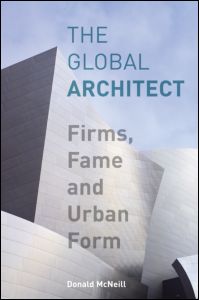
The Global Architect: Firms, Fame and Urban Form by Donald McNeill, Associate Professor at the Urban Research Centre, University of Western Sydney, Australia, provides a fascinating insight into the effects of globalization on both architecture and the built environment. Described as a "critical sociological overview of the current global architectural industry" McNeill, in a thoroughly researched and well-referenced book, explores a period of architecture and city development in a post-Bilbao world when the culture of the spectacle was fully embraced by local governments, big business and architectural firms. The contingent nature of the architectural profession is exposed through a series of case studies from both household names and corporate giants, exploring interrelated issues of aesthetics, technology, culture, economics and politics. Whilst the growth in 'Global Modernism' has been well documented in recent years McNeill is able to provide new perspectives on these issues and begins to challenge the ethical standpoint of the profession and their involvement with the sometimes hidden aspects of the design process.

The Global Architect: Firms, Fame and Urban Form (Routledge, 2009)

The book opens by observing that the mobility of architecture and the architectural star system is not a new condition, accounting how Louis XIV invited Bernini to Paris to work on the Louvre in 1665. McNeill though is quick to point out that "the territorial boundaries that had kept most architects tied to a small set of national markets no longer make much sense for design firms capable of operating in the dynamic economies of the Gulf and China." So whilst the majority of architectural practices still rely substantially on work in domestic or regional markets there has been a proliferation in firms working globally on a more regular basis. The key causes for this are reasoned as the hyper-mobility of "advanced business services" (which architecture is often described as), a desire by larger firms to diversify workloads to cope with recessions in domestic markets and "corresponding growth strategies of transnational corporations" - with those corporations bringing their favoured design companies into new markets with them.

An analysis in Chapter One, "The globalisation of architectural practice", compares different models of architectural practice - the "globally operative megapractice" (Skidmore, Owings, Merrill), "the architectural firm as global brand" (Aedas), "the Foster model" (Foster + Partners) and boutique-firms. Commenting on the trend towards mergers and amalgamations of practices into even larger firms, McNeill sees the future of the 'boutique' practice as assured "assuming they are able to offer something distinctive within a crowded market" and as such the continuation of the distinction between 'executive' and 'design' practices.

Chapter Two, "Designing at distance", deals with the issues surrounding architectural projects designed hundreds or possibly thousands of miles away from the project site. Key to this are technological innovations that have "transformed the architectural design process" and the increasing popularity of outsourcing, a key feature of the 'new' economy, where "low-wage but skilled labour" deals with "routine parts of the production process." In this new cycle of 24 hour working a confidence in new technology, for rapid information transfer, means that 'design-led' firms no longer need to open outpost-offices where projects are being undertaken and smaller firms can take on much larger projects (as 'design' architects). Drawing on the work of William Mitchell in Me++: The Cyborg Self and the Network City McNeill describes how "the individual architect is thus involved in a network of relations facilitated by a mix of face-to-face meetings and socialising, telephone conversations, video and web conferencing, emails and projects intranets." These face-to-face encounters are still key to facilitating the design process, meaning that the 'design-team' can never be completely autonomous from the site.

"The cult of the individual" and "The 'Bilbao effect'" are covered by Chapter's Three and Four respectively with both tackling the desire of governments and businesses to seek out a signature architect to design an iconic building - and for architects to be sought out to act as agents in this process. Architecture is "not like painting or sculpture or even film-making, given the incredible complexity of the design process" however architects are now required to develop "public narratives" (be it dress sense or PR campaigns) within their professional lives to sell schemes to potential clients and the public. The Guggenheim Museum in Bilbao and it's subsequent role in 'regenerating' the city has been well documented yet McNeill is able to draw out a "a hidden side of the Bilbao effect" that moves passed the pure spectacle of the architectural form and analyses other "serendipitous" contingent forces that led to the success of the project.

The career of Rem Koolhaas is examined in Chapter Six, "Rem Koolhaas and global capitalism", and how he has revelled in "redefining the role of the architect in all the social and technological messiness of the contemporary world economy." Key to this has been the self-examination by Koolhaas and his practice, OMA, that has led to him to blurring the boundaries of what exactly an architect does; by subverting "the architect as autonomous professional" and embracing "the power of the client in determining the process." McNeill is quick to point out that "accepting that the client's goals and budget define the architectural response is not new" but the pragmatic approach championed by Koolhaas through volume's such as S,M,L,XL and Content, with a hint of irony at times, has influenced a generation of architectural students.

Undoubtedly the skyscraper is an "icon of Modernity" and any text examining the globalised architectural profession would be incomplete without acknowledging it's part in the story. Chapter Six, "The geography of the skyscraper", deals with the relationship between the exportation of "an American hegemony in world politics and culture" and the rise of the skyscraper as a "monument to national state prestige" in the post-colonial world. This chapter also deals with issues of cultural identity; McNeill becomes increasingly critical of the 'one size fits all' mentality and the proliferation of gestural motifs, within 'Global Modernism', to represent specific cultural identities - "The assumption that there is a unified, essentialised ... national identity fails to recognise that nations are social constructions, built up over decades and centuries of conscious myth-making."


Donald McNeill uses the CCTV Headquarters, Beijing, China,
by OMA, to highlight the ethical dilemmas architects face
(Image from OMA website copyright of Iwan Baan)


With a growing degree of criticality McNeill's attention turns in the final chapter to "The ethics of architectural practice". There are an array of 'ethically challenging' scenarios that architect's find themselves working within, either specific building typologies, "dubious regimes or clients" or issues of 'sustainability' and McNeill views these areas as being "increasingly problematic." One of the key case studies highlighted in this chapter is the recently completed Headquarters for China's state television station (CCTV) which brings into question the importance of politics in contemporary architectural discussions. There seems to be little interest in architectural ethics which McNeill partly puts down to architecture's self-referential nature and the split between architecture as 'art' and/or 'profession'. Ultimately though, for McNeill, the mentality of 'if we didn't design it, someone else would' "only serves to highlight a worrying abdication of ethical responsibility by some of the world's leading design firms."

To conclude then, The Global Architect deals with a vast array of issues as it traces the history and consequences of globalisation in the built environment industry. Whilst the issues here are covered in numerous other texts - as highlighted by the number of sources cited - the book forms part of a growing critique of the output of the architectural (and construction) profession in the recent years. McNeill is able to bring together a variety of different stories, with a vast array of actors (despite the pool of global starchitects being admittedly limited) into a coherent account that offers new insights into the contingent forces at play in shaping the urban environment.

Notes

McNeilll, D. (2009), The Global Architect: Firms, Fame and Urban Form, 1st Edition, New York: Routledge

31 January 2011

Which Faculty?

If 'Architecture', as a quasi-vocational subject of some sort, is to be taught at academic institutions in the UK a key question must be "where in the academic structure is architecture placed?" (Teymur) and what are the consequences of this for the profession of architecture.

Whilst it is obviously an over simplification of the education process to assume that the academic department, in which architecture is placed, alone influences the nature of education the importance of the academic structure that architecture 'fits' into shouldn't be ignored. The academic structure will surely have some impact on the teaching of architecture at that institution, with the connections  present within that faculty between different departments (based on which subject areas that institution views as concurrent), exposing students to other academic interests. As such there is a link, either direct or indirect, between this 'fit' and the sort of architects students of that institution will become (if indeed they are to become 'architects' in the 'traditional' sense). Furthermore as Teymur, in his series of papers on architectural education in 1992, also observes "the desire to identify architecture as, say, technology and/or craft and/or science and/or art throughout the centuries betrays the very paradox of the idea of architecture both as a multi-disciplinary, multi-skilled, multi-dimensional and multi-media practice."

An analysis of the architecture courses offered in the UK, based on both RIBA validated courses (including candidate courses) and UCAS K100 'Architecture' courses (those courses 'sold' to potential undergraduates on completion of their A-Levels), reveals a wide range of different faculties and departments in which architecture is placed. The majority of UK institutions have an 'Architecture School/Department' with a number of these operating as 'independent' faculties in their own right. However, there are also a number of institutions with no 'sole' architecture department and instead it sits, as a subject, within a wider faculty, for example 'Art, Architecture and Design'.

Architectural Education in the United Kingdom
Department/Faculty analysis & RIBA validated courses per Institution

The analysis undertaken (see above for the graphic representation and full analysis) involved recording key terms used  in a faculty title and the first 'sub' department that architecture may or may not have been taught in within that faculty (no recording of third tier or 'sub-sub' departments was made). This revealed the following terminology used in faculty structure: Architecture, Landscape, Interior Design, Construction, Planning, Surveying, Science, Technology, Computing, Engineering, Civil Engineering, Art, Design, Media, Humanities, Social Sciences, History of Art, Culture, Development, Environment, Built Environment and Natural Environment. That such a wide range of terms are used in trying to find a 'home' for architecture within the current education system is a reflection of the wider issues surrounding the role of architecture in society today and the historical tensions regarding the multi-disciplinary nature of the profession.

Architectural Education in the United Kingdom
Differentiation of Degree Certificates award by RIBA validated courses

Further divergence between institutions can be found when examining the different degree certificates offered by UK institutions. Architecture is not unique it lacking a unified and sole degree classification however the range of degrees on offer to students (see above graphic) is another sign of the difficulties in defining architectural education academically in the UK. What impact does having a Bachelor of Arts as opposed to a Baceholar of Science have and does it represent a different method of architectural 'teaching'? Or is it simply irrelevant and all the degree really constitutes is a means to an end - exemption from RIBA Parts 1 and 2.

It seems highly unlikely that architectural education will return to Pre-20th Century model of articulated pupillage so the role of academic institutions within the education process must be more thoroughly understood and the consequences of this examined. This differentiation undoubtedly leads to a richer profession with students exposed to other individuals who do not necessarily see the world from an 'architectural' view point; preparing them (to a limited extent) for interacting with non-architects in their future lives. The contingency of architecture is thus influenced by the other academic departments it has to share resources and work with at UK institutions, further complicating the debate of architects and their place in the 21st Century. This contingency does not guarantee 'good education' nor for that matter does it imply 'bad education'; as Teymur similarly notes, "'good architecture'(?) does not guarantee 'good education' in the same way that good education, though necessary, may not be sufficient to secure good architecture."

Notes

Teymur, N. (1992), Architectural Education: Issues in educational practice and policy, 1st Edition, London: ?uestion Press
University & Colleges Admissions service [Online] Course search for 'Architecture' and 'K100' [first accessed 29th January 2011] http://www.ucas.com/
Royal Institute of British Architects [Online] List of UK Validated schools, November 2010 [first accessed 29th January 2011] http://www.architecture.com/Files/RIBAProfessionalServices/Education/Validation/2010/UKSchoolsList.pdf


19 January 2011

Review: Architecture's Evil Empire?

Architecture's Evil Empire? The Triumph and Tragedy of Global Modernism is Miles Glendinning polemic book that passionately challenges the recent history of global architecture and its desire for iconic forms as a tool to regenerate post-industrial cities the world over. Glendinning seeks to find a solution to the problem's he perceives profligate an industry fuelled by both public and private bodies that has created a raft of projects across the globe "stridently disconnected from their visual and social context". However, as Glendinning accurately observes "contemporary architecture is like an iceberg. the excesses of signature icons are just that bit that sticks above the surface, whereas the really intractable part is the great mass that lurks beneath, invisible to public scrutiny". Clearly any 'solution' will have to have to reach down to the 'core' of society and be part of a wider readjustment away from the cult of the spectacular and celebrity that has defined the past 20 years - not just the architectural profession.

Architecture's Evil Empire? (Reaktion Books, 2010)

Miles Glendinning, a Reader in the School of Architecture at the Edinburgh College of Art and Director of the Scottish Centre for Conservation, opens the book by looking at the recent example of The Public, West Bromwich, part of a wave of large lottery-supported projects and has suffered "the same problems of grandiose initial scale and inadequate resources for running costs." It is here that Glendinning introduces the notion of an 'Empire' of 'New Modernism' which was (and perhaps still is) dependent "on the values of individualism and competition, and veneration for the symbols of capitalist commercialism" in direct contrast to the 'traditional' notion of international architectural movements that were also rooted in specific a specific country, city or place. However, in his view this Empire is not an 'evil' one but instead is 'tragic' one, mirroring the great tragedies of Greek story telling, because of "the good intentions, the idealism even, of all involved in building up a structure that would, by its own impersonal momentum turn so comprehensively rotten".

In four chapters Glendinning traces the history of this Empire, observing that "it is not use condemning without understanding", an important assertion that helps add weight to his argument. Moving quickly from Vitruvius, through the individuals of the Renaissance, he stops briefly to assess the impact of Beaux-Arts model in the later stages of the western world's industrialisation before moving into the beginnings of Modernism. This is a time, he suggests, that reflected a 'rejection of the individual' in the architectural profession but that this situation began to change in the later half of the 20th Century. A wealth of sources, texts, buildings and key figures in architecture and urbanism feature as Glendinning tracks "the drift of disintegration" from Modernism to Postmodernism and a "retreat to the city".

The idea of a New Modernism is framed first with the introduction of the 'High Tech' "showing that there were elements of the Modern movement style, or styles, that could be salvaged and adapted to help build a new, more market-orientated society." The importance of 'deconstruction' in architecture is highlighted as a key influence. Rem Koolhaas's seminal text 'S,M,L,XL' is held up as the "foundation stone" of the Empire which represents the 'new theory' and the "great deal of research [that] goes on, but no longer with any idea of contributing to some wider strategy of social salvation, or even of giving any real intellectual substance to an otherwise disorientated landscape". This is part of a wider trend in which research has been converted in to "a kind of spectacle". If 'S,M,L,XL' is the 'bible' of New Modernism then the "foundation monument" for Glendinning is the Guggenheim Museum in Bilbao, described as being "blatantly direct where S,M,L,XL was subtly oblique" and "startingly individualistic and (at the time) unprecedented". The role of the 'Bilbao Effect' has been much documented and these previous discussions are referred to in the book.

As the book progresses a growing image of despair is unravelled and a "discarding of order" in a world of "disconnected form and construction" is revealed - an interesting juxtaposition in a world where connections between individuals are becoming more frequent through the proliferation of various media and technological devices. The critique here moves beyond simple arguments about the relevance of iconic form and into the realm of urbanism and planning on a larger scale - "iconic intervention versus urban cohesion". The rhetoric of 'context' was often used as a method of combating the 'generic' however Glendinning highlights a number of examples where the metaphorical use of context has just created further disconnections.

It is in the final chapter that Glendinning offers some solutions to the disconnected landscape he has been describing. He recognises that "in stark contrast to the brash ebullience of much of the rhetroic of New Modernism, the last few years have witnessed a steady escalation of architectural attacks on the movement" whilst a 'pass the parcel blame game' began amongst architects, journalists and critic-apologists. Central to his proposals are ideas of 'genius loci' and "the resurgence of place", though he is quick though to distance himself from ideas of 'critical regionalism', with inspiration coming from the work of Patrick Geddes in the late 19th Century and early 20th Century. Ultimately though what Glendinning is searching for is for a "fresh era of socially grounded modernity".

In the end then this book serves two useful purposes. First of all it offers an insightful and scholarly account of the previous 20 years in architecture. The 23 pages of references highlight the wealth of sources and case studies considered by the author with the right amount of information disseminated for each, neither do you feel overwhelmed by the information offered or under-informed. Secondly, the calls for "architecture to come back down to earth" are much needed within the profession and it begins to ask questions of what exactly we, as society, want from our buildings and the built environment.

Notes

Glendinning, M. (2010), Architecture's Evil Empire? The Triumph and Tragedy of Global Modernism, 1st Edition, London: Reaktion Books

16 January 2011

Codes and the Built Environment (MARC Research Symposium)

On Monday 11th of October 2010 the Manchester Architecture Research Centre (MARC) hosted a research symposium which sought to address "the influence of codes on the design, construction and habitation of cities." The speakers were drawn from a diverse range of scholars, with a number of academic interests that all touched upon the notion of 'Codes and the Built Environment': Steven Moore (University of Texas at Austin), Rob Imrie and Emma Street (King's College London), Matthew Carmona (UCL), Jeroen va der Heijden (Delft University of Technology), and Michael Guggenheim (University of Zurich). To further quote the advertising for the event:

"All elements of the city - from buildings to streets and from parks to transit networks - are influenced by a multitude of overlapping, reinforcing, and sometimes conflicting regulations that have accrued over decades or even centuries. Social scientists and designers have only recently begun to study the historical, political, and cultural aspects of code production and deployment as well as the particular material and social configurations they produce."

What will follow is a series of short summaries that describe the topics discussed during the five presentations given as part of the event by the various guest speakers.

The example of codes in the built environment used
on the flyer for the event hosted by MARC.

Steven Moore: "Taxonomy of Socio-technical Codes"
Starting with an assumption that "Building Codes are an index of changing social values and a strategy to enforce those values" Dr Steven A. Moore proceeded to give an insight into his current research interests. He touched briefly upon a number of areas, including current projects being undertaken in post-Katrina New Orleans, and cited other research projects by a number of other individuals, including a number of speakers present in the room. Highlighting the taxonomy of existing code types (labelled Tacit', Sumptuary, Economic and Socio-technical) Moore went on to question "How do you construct socio-technical codes?"

Rob Imrie & Emma Street: "Architectural Design and Regulation"
Imrie and Street's presentation attempted to give a condensed version of their forthcoming book 'Architectural Design and Regulation' (February 2011). Jointly they attempt to "put the social into architecture" within, what they perceive as, an "oppositional culture" of architecture and building. They postulate that "rules and regulations are constitutive of the process and practices of architecture" and are "not external to the creative processes and practices." The importance of the regulatory society is viewed as being a new key agent in their discussions and "regulatory controls are anathema to the delivery of a modern urban infrastructure and environment." Imrie and Street see the dualism within the architectural profession as a false distinction that stems from the discourse of "architect as art" which has been reinforced by further dis-juncture  between training and practice. An interesting observation was also made with regards to how the wider culture of risk and litigation in society has influenced the design process as well as the inter-relationship between Architects and other professionals (or as they put it "the relational networks or socio-institutional and political interdependencies.") The book (see below) would seem to deal with a range of interrelated topics and the short presentation by the pair gave only a flavour of each, leaving the audience feeling slightly frustrated. You often needed to know and understand, in more depth, the research behind certain statements which was only forthcoming on further questioning but would undoubtedly be far more accessible in the text or a longer presentation.

Architectural Design and Regulation
(Wiley-Blackwell, 2011)

Matthew Carmona: "Good Codes/Bade Codes: Coding for Creativity and Value"
Drawing upon his own research, publications and surveys Matthew Carmona, Head of Planning at the Bartlett, began by showing a number of examples of "the bits they [governments] don't show" when advertising cities, highlighting sprawl as "the inevitable consequence of our development process." He observed that it is an "interesting time for design because it's the law" referring to codes and standards that demand 'good design'. However he was highly critical of how these codes and standards don't quantify what constitutes 'good design' and as such outcomes remain poor - for instance a survey by CABE on new housing rated only 6% as 'good' and 24% as 'poor'. He said that today "we excel at making codes but fail at making places" and that the current condition is exacerbated by three professional cultures: creative tyranny, market tyranny, and regulatory tyranny. The challenge seems to be how the various professions involved in the built environment "mediate the tyrannies of participation" however codes, in Carmona's view, "do not deliver an outcome but do have a role to play in the process" - with the research from his publication 'Design Coding in Practice: An Evaluation' used as evidence to support this basis.

Jeroen van der Heijden: "Good Enforcement/Bad Enforcement: How Enforcement Matters in Achieving a Safe, Healthy and Sustainable Built Environment."
Central to Jeroen van der Heijden's presentation was the notion that whilst "it may be possible t design codes on paper [the] real enforcement issues must always be considered." He described how there are two types of code, prescriptive and performance-based, and the "grey area of compliance" which surrounds both before stating that prescriptive codes are the easier to measure and enforce. The various different enforcement strategies encountered by van der Heijden were characterised as being either: deterrence based (force of law); compliance based; incentive based; or risk based. Further differentiation is found in the enforcement style, either rigid and legalistic or facilitative and consulting, which is used by the various different actors present in the enforcement process - government agencies, market organizations, third sector/NGOs, the general public or some form of hybrid organisation. He surmised that the level of enforcement was possibly tied to the level of litigation and liability present in a system but that this required further research.

Michael Guggenheim: "What Legal Coding Can('t) Do: Of Prayers and Assisted Suicides"
Two case studies were used by Michael Guggenheim to highlight relationships between laws, building form and building use, with an approach that viewed both buildings and regulations as a quasi-technology. The first case study focused on Mosque's in Switzerland and whether or not the addition of a Minaret constituted a 'change of use' in planning terms. Dealing with issues raised from the right-wing movement in Switzerland to ban the building of Minarets, that became law in 2009, Guggenheim challenged the extent to which certain typologies and building forms can be codified. He raised the question as to whether or not a converted Church tower would be classed as a Minaret and therefore would it then have to be demolished. This served as an example of the limitations of such codes and the extent to which certain forms are interrelated to particular uses  - is a building (or building element) a certain typology through its form or what it is used for? The second case study looked at assisted suicides and how regulation in Switzerland had led to the growth in 'death tourism'. This case study focused on Dignitas and local oppositions to 'death tourism' and whether or not it's practices constituted 'allowed' activities within certain district zones. The dispute that arose as a result of conflicting and confused zoning laws was about coding for use, whereas the previous case study had looked at issues involving coding for form. Guggenheim concluded the assisted suicide case study by stating the a new 'suicide' typology within Swiss zoning law was needed.

Mosque of the Olten Turkish Cultural Association at
Wangen bei Olten, one of four Minarets in Switzerland and the
last built before legislation banning their construction was passed

Thesis: Initial Thoughts

The time has now come for me to begin to formulate my initial thesis proposal for the MA in Architecture and Urbanism I am currently studying for at the Manchester School of Architecture. When applying to the course I had to submit a brief outline of what I would like to study and it is from this that I am beginning to develop a proposition to engage with more thoroughly. My application material highlighted an interest in: the complexity of the contemporary construction process; the role of "design" versus "executive" architects; responsibility and the rejection of liability by architects; the banal versus the iconic; the role of architects in 'place making'; how procurement methods and legislation are used as opportunities, not restrictions, in the design process. These curiosities have come about due to a number of factors with the below image highlighting some of the key influences over the previous 18 months.

Initial primers for research - scattered on a coffee table -
the connections are often clearer in my head (September 2010)

Key amongst these influences is an interest in finding 'pragmatic solutions' as opposed to imaging unachievable utopian visions, working with existing urban frameworks (policy, regulation, economic conditions, social conditions). Examining and working with existing conditions is a trait often found in the work of architectural practice OMA, in particular the writings of Rem Koolhaas who's theoretical position has been more influential, in many cases, than his built works. The influence of OMA spreads to a number of other practices including BIG (Copenhagen), JDS (Brussels) and REX (New York) who have previously worked under Koolhaas. This is not to say that other architects don't take the same approach however it is the 'OMA School' that has been more extensively published. Examining this approach and the research surrounding it will undoubtedly provide a wealth of information to draw upon.

Observations about the division within the architecture profession, principally the split between executive and design Architects, is not a new idea or theme, they have been made for over a century. Recent additions to this discourse include comments made by Bjarke Ingels, in his practice's manifesto 'Yes Is More', that "historically the field of architecture has been dominated by two opposing extremes." Ingels defines his approach as "operating in the fertile overlap between the two opposites. A pragmatic utopian architecture that takes on the creation of socially, economically and environmentally perfect places as a practical objective." This has undoubtedly been informed by his associations with OMA.

The work of Jeremy Till was also key to formulating my application proposal and will undoubtedly provide key insights as I develop my proposition further. His recent publication 'Architecture Depends', provides an insightful account of the dependent forces within the architectural profession and the role of contingency within it. As Till puts it "we must bridge the gap by opening up to dependency not as a threat but as an opportunity" working with the "mess" of the everyday. Also of interest to me are the observations made by Till that "the contingent researcher welcomes each new book with a sense of curiosity" - this is an approach I intend to use in my own research, to work as a contingent researcher.

Since then a number of other texts/arguments/ways of thinking have come to my attention, principle among those has been the 'call to arms' led by Winy Maas and The Why Factory in Visionary Cities. In this brief discourse, born very much in the depths of a 'crisis', architects, urbanists, designers and society are challenged to meet the 12 urgencies or critical urban issues that they see as most relevant today - the solitary (dreams); the iconic; the fun; the miniature; the complex; the cautious; the faithful; the green; the poor; the old; the re; the future. As they eloquently put it "While Pritzker Prize-winning Architects are designing Vodka bottles and necklaces, unknown Developer-Architects are building entire cities from the ground up" whilst "the city is being held hostage by procedure." The challenge is thus to better understand the complex relationships that exist but also to tackle the design process itself - the design process itself can become the subject of design. This involves taking a similar approach to the "eco-effective" approach proposed by Michael Braungart and William McDonough in Cradle to Cradle. Designers should "expand their vision from the primary purpose of a product or system and consider the whole" and embrace "the challenge of being not only efficient but effective with respect to a rich mix of considerations and desires." Of course, part of this is understanding the current system and it's failings, there can be no point in blindly starting from scratch and coming up with an equally flawed system.

Traditionally the architectural profession is a slow one, slow to adapt and to change. Today it operates in a world where connections between places, cultures and economic markets are rapidly increasing. These external forces manipulate and affect a design process that was already a notoriously complex system, full of contradictions when you consider the dependent forces whom and that are at play. Architects seem to be struggling to adapt to these conditions and their is a feeling of disbelief amongst pockets of the profession as the role of the Architect is diluted - loosing out to other, more adaptive and responsive (or pro-active), professions leaving architects continuously lurching from crisis to crisis. Are architects at times their own worst enemies in propagating this situation? Have they refused to accept responsibility and rejected liability which has in turn affected their status with the industry and society? Does it even matter?

In brief summary then my thesis will be an investigation into the role of professionalism within the 'Architectural Profession' and how this impacts upon our cities and urban landscapes. Some of these investigations are already present on the blog - they are the things that I am interested in - others will appear over time, as will developments in my thesis proposition.

Notes

Till, J. (2009), Architecture Depends, 1st Edition, Cambridge, MA: MIT Press
Maas, W., Sverdlov A. and Waugh, E. (Editors) (2009), Visionary Cities (The Why Factory), 1st Edition, Amsterdam: NAi Publishers
Braungart, M. and McDonough, W. (2002), Cradle to Cradle: Remaking the Way We Make Things, 1st Edition, North Point Press

14 January 2011

1946 'Self-measurement' Form

In the aftermath of the Second World War, with the architectural profession optimistic about it's future with the promise of rebuilding the UK's cities, Clough Williams-Ellis published 'The Adventure of Building.' Sir Bertram Clough Williams-Ellis (1883-1978), an English-born Architect, is best known for his work designing and building, in an Italian-style, the village of Portemeirion in North Wales (1925-1975). Within the book Williams-Ellis sets about providing an introduction to the world of architecture and planning, with a focus on providing an insight for "intelligent boys and girls" so that they "may perhaps decide whether [his] much-loved profession is to welcome them."  To aide in helping children make their career decision the book includes a 'self-measurement form' which Williams-Ellis has crossed to mark the qualities he sees are most important for the Architect of 1946 and the future.

'A self-measurement form' Part 1 (Architectural Press, 1946)

The form, devised by Amabel Williams-Ellis, his wife, featured in a book on careers entitled 'What Shall I Be?' and was originally produced by the Hon. Nancy Samuel.

'A self-measurement form' Part 2 (Architectural Press, 1946)

The book doesn't just 'pitch' itself to young persons, as the sub-title suggests - "Being something about Architecture and Planning for intelligent young citizens and their backward elders." William-Ellis is also trying to educate the general public so that they are more informed when discussing architecture and building. In his view the only person who's opinion you should follow or take notice of, regarding architecture, is someone who is inclined "to spend quite a lot of time looking at buildings and thinking and reading about them, trying to sketch them or perhaps even to design others, and always ready to discuss them keenly." His view that it is only "then that person is worth listening to, and will probably talk sense" is rather telling - "He [the educated individual] knows - therefore he probably cares."

Notes

Williams-Ellis, C. (1946), The Adventure of Building, 1st Edition, London: Architectural Press